While the Estian Islands are a melting pot of races and cultures, each group still have different values and observe separate traditions. Some of the species presented here are ones found in WotC printed material, in which case they provide lore, context, or additional options. The rest are homebrew races, which are available for use when you create a character.
Playing a species not on this list is allowed, but brings a higher degree of responsibility for ensuring you fit into the world.
Humans
Humans are a diverse and multi-cultural species, only united in their adaptability. Each distinct culture has different ideals that they strive for - some value wanderlust, others property, love, or knowledge. The strength of humans does not come from excellence in any single area, instead it comes from their extreme versatility, and their ability to organize themselves and perform great works through cooperation. Humans have spread to every corner of the world from the arid desert to the frozen tundra and the wet jungles, living in communities ranging from tribes with only a handful of individuals to great metropolises with tens of thousands of inhabitants.
Elves
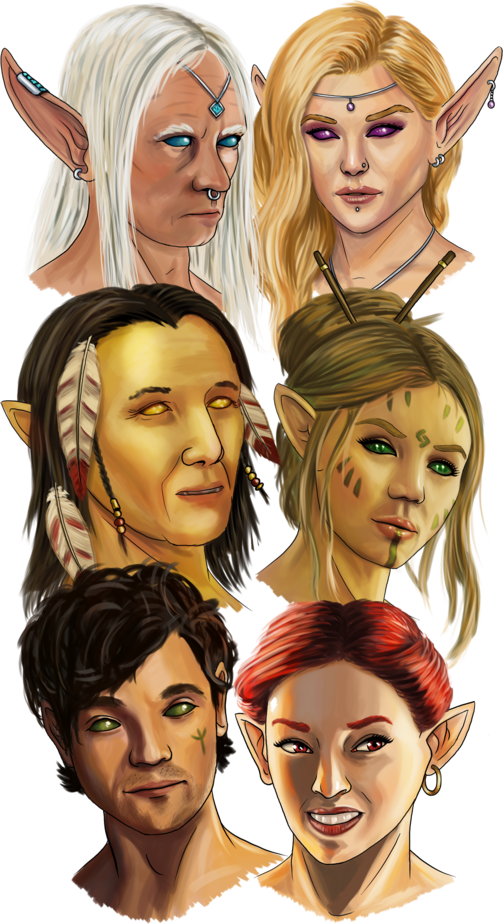
From top: High elves, Wood elves, Half-elves.
From a distance, elves and humans look similar, elves growing perhaps a little taller and lither. Up close however, there is no mistaking them: elf eyes have no pupils, their eyes are a solid color with much variation in hue and brightness. They also have more pronounced cheekbones, and their ears are longer and pointed. Elves most commonly worship the Vanir, which are traditionally depicted as elven.
Their lithe build and complete lack of body hair makes elves prefer higher temperatures than most other races. It is not uncommon to see elves bundled up in furs when others are fine in a lighter tunic, and elven homes often have a fire going.
Elves take much pride in teaching their young in artistic pursuits, magical scholarship, or martial prowess. It is not uncommon for elves to set out adventuring for a few years when they are young, but most settle down afterwards. Martially minded elves fight with many types of weapons, usually preferring ones requiring agility and skill over brute force.
Elves live much longer than humans, about years. This long lifespan makes them less concerned with the passage of time. Elven names are a complex system of honorifics and descriptors, but most describe the circumstance of their birth, such as Silwen, 'Star-lady' for someone of high birth born during a particularly starry night.
Over the aeons, elves are shaped by the essences of where they live. All elves descend from the eladrin of Alfheim, the Feywild. The ancestors of the material elves migrated to the relative peacefulness of the material plane many thousands of years ago. The material elves have split into two distinct, but still closely related kin, the sylvan wood elves, and the proud high elves. All elves still maintain a connection to their ancestral home, often choosing to settle in areas influenced by that plane.
Despite their outward differences, both wood and high elves share a large part of their culture. They do not put much emphasis on heritage, as long as it is elven.
Smallfolk
United in their stature, gnomes and halflings are collectively known as smallfolk, and their cultures are quite similar. They share a common ancestor and can have children, who take on the characteristics of its mother. Sometimes, dwarves are also included in this category, although they are very different from gnomes and halflings.
Appearance-wise, halflings have more human proportions, while gnomes have slightly larger heads and hands for their size.
Planetouched
Some humans carry the essence of some other plane of existence within their being. This usually happens through a blood connection to a powerful entity from that plane, but can also result from being born in close proximity to such power during. These people are far more likely to develop magical ability, usually of a similar kind to that of their ancestor. These heritages can skip several generations before revealing themselves, and then fade back again.
While elves can also become infused with essences, they do so over eons, while humans can achieve the same thing in a single generation.
The lifespan of plane-touched humans heavily depends on the purity and power of their ancestry. It can vary from no longer than a regular human to over 400 years, but the latter case is vanishingly rare. Very generally, aasimar and astralites are the most long lived, followed by genasi and changelings, and then tieflings, but there is much overlap between them.
| LG Water Genasi | NG Aasimar | CG Air Genasi |
| LN Astralite | TN - | CG Changeling |
| LE Earth Genasi | NE Tieflings | CE Fire Genasi |
Sylvanites
The sylvanites are the inhabitants of the Feywild. These races descend from the Great Spirits of the ancient world.
Outsiders
While they are not unheard of, these races are far less numerous among normal people. However, they are less rare among adventurers. This category includes the monstrous races and other exotic heritages.