Tecca Victor!
At its greatest extent, the Teccan Empire spanned almost half the continent. Its founding marks the start of the reckoning of years. Internal conflict and arrogance from its leadership caused its eventual downfall 250 years ago, in the year 1189.
Emblem
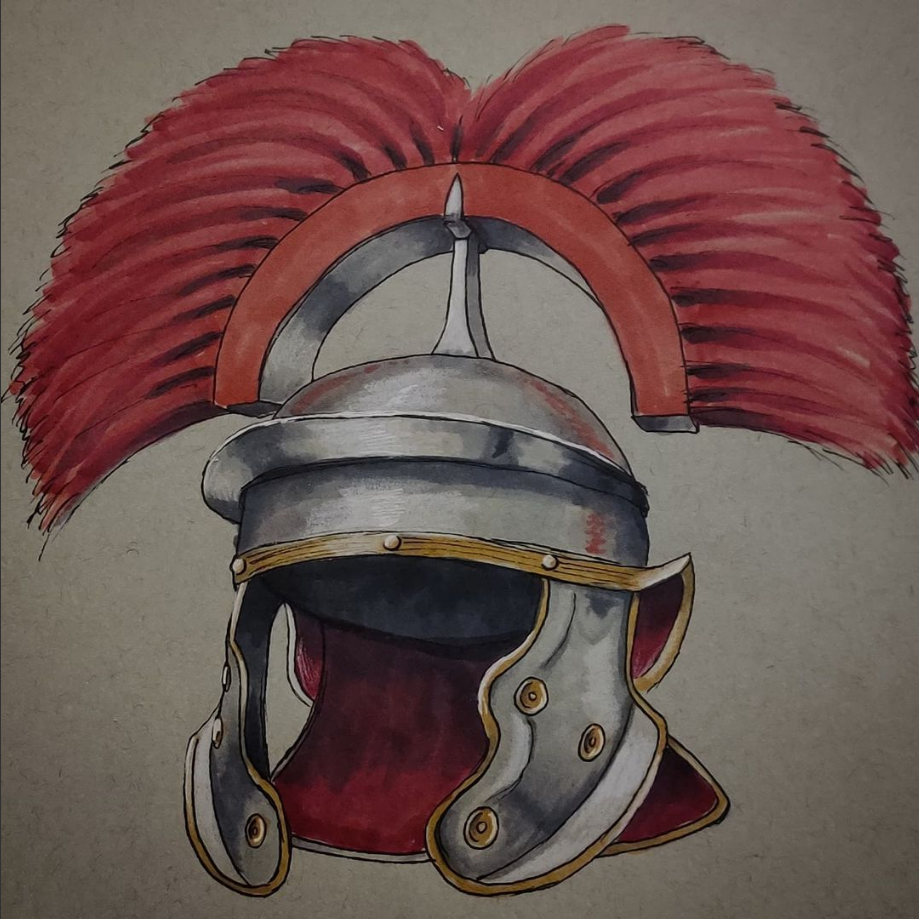
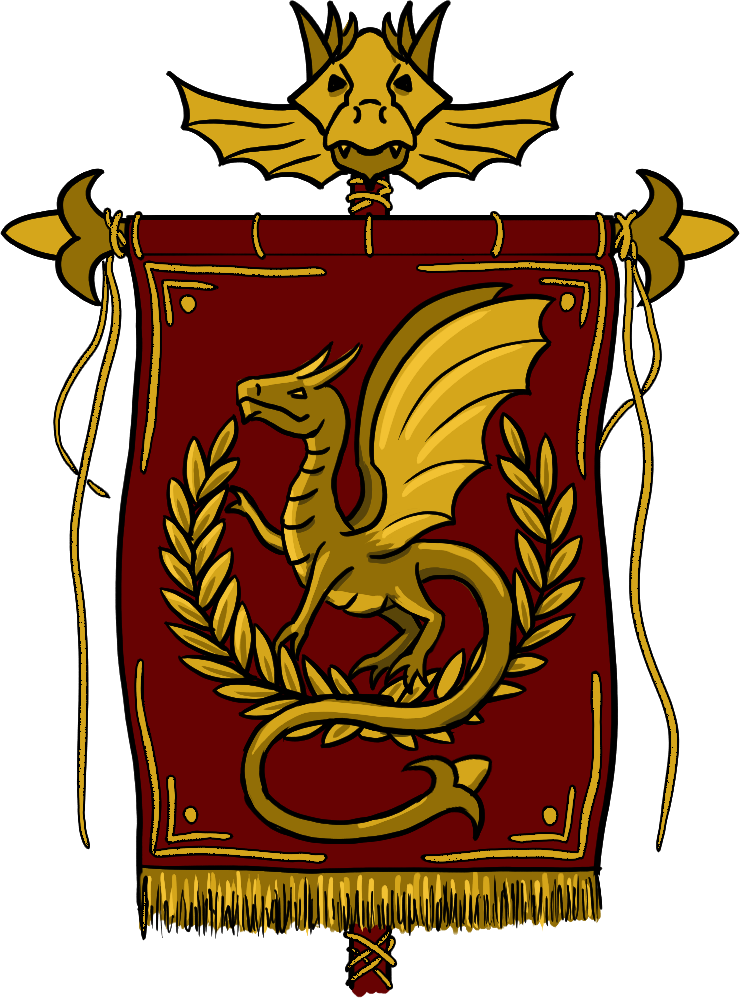
The emblem of the Teccan Empire is a golden dragon inside a wreath of golden laurel leaves, on a field of carnelian. The red-and-gold color scheme is also used for the armor of the Teccan Legions.
Teccan names
All Teccan names consist of a first name and a patronymic, which is simply the person's father's first name. Noble families also add their clan name as a final third name. The clan name is usually the first name of the founder of the family, but can also be a by-name.
Non-human Teccan citizens are also expected to take a Teccan name, but this might be a translation or transliteration of their original name. This is common among halflings, gnomes, and even some dragonborn.
Examples:
- Augina Regius: Augina, daughter of Regius
- Octian Octian: Octian, son of Octian - this type of reduplication is common.
- Titilia Victor Iphilia: Titilia, daughter of Victor, of the Iphilia clan.
The Imperial Legions
During its heyday, the Imperial Legions kept the peace in the vast lands of the empire, both from external and internal threats. The Legions were fearsome fighting forces, employing both phalanxes of spear-wielding footmen, missile regiments, cavalry units, and formations of mages. The development of a combined arms doctrine was one of the key developments that led the legions to their successes.
Organization
Each Legion can operate as an independent unit, or several legions can join together. A person in command of several legions carries the rank of marshal.
Each legion, commanded by an imperial legate, roughly fields:
- Twelve centuries of 100 infantry. Led by the first centurion, who is also second in command of the entire legion.
- Each century is led by a centurion. The century is further divided into four maniples, each led by a sergeant.
- The centurion is also assisted by a first sergeant and a signifer, who carries the century standard.
- The infantry are equipped with large shields and spears. They fight in tight phalanx formations, usually three ranks deep.
- Eight companies of 60 skirmishing missile troops (usually archers, but sometimes slingers). They are commanded by the quartermaster, who is also tasked with ensuring the legion is fed and housed.
- Each company is led by a captain.
- A company is made up of three troops. Each troop is led by a lieutenant.
- These troops are lightly armored to stay mobile. Their job is to provide screening and missile support to the infantry.
- Two of the companies are engineers. They are responsible for fortifications, emplaced weapons, and siege machines.
- Each company is led by a captain.
- Four echelons of cavalry, each 50 strong. Each echelon operates individually under a paragon, directly commanded by the legate.
- During marches, the echelons and the companies are deployed ahead of the main column as foragers and scouts.
- A single flight of 50 mages. The arcanist commands the flight.
- The mages vary in specialization. Some rain down destruction on enemy forces, others try to stop enemy spellcasters from doing the same by casting arcane wards, and some provide healing for the wounded.
- Various backline and support troops, such as cooks, medics, scribes, carters, messengers, trumpeters, standard-bearers, and more. These could number as many as several hundred in a marching legion, and many more when stationed in an outpost.
The actual strength of a legion can vary quite a bit from this blueprint. It was not uncommon for a legion to take on a second flight if going up against a magically gifted opponent, or bring a second company of engineers if an extended siege was expected.
Each century, company, echelon, and flight train together and can be reorganized to suit the needs of a certain mission. A soldier is trained to feel more loyalty to their regiment than their legion, as the legion will change many times, but changing regiment is more rare.
Recruitment
Upon recruitment into the legions, each soldier is assigned to a regiment. Most contracts span twelve years, after which a pension is earned. Pay during the contract is low, but equipment is provided, there is no cost of living, and there is always the opportunity for loot. Many from the poorer provinces see the legions as their ticket out of poverty.
During times when recruitment was low, certain criminals were also offered legion contracts as an alternative to other forms of punishment. Upon completion, they were considered free men again.
Officers
Each legate was appointed by the Imperial Senate to a certain term. The high officers (the first centurion, the quartermaster, and the arcanist) advise the legate on the best way to execute their mission. With the legate often chosen for political reasons rather than military capacity, this advice of often well heeded. Some Legions were more or less ran completely by the first centurion, with the legate acting as a figurehead.
The junior officers (sergeants, lieutenants) are promoted by voting among the rank and file of their unit. Becoming an officer in the imperial legion is an honor that brings good prospects once their contract is over, and a major boost to pay.
The senior officers (centurions, paragons, captains) are appointed by the legate, choosing among junior officers who have excelled in their tasks.
All officers wear a red sash over their chest, with upper officers gaining a second sash to be worn in a saltire on the chest.
Commendations
If a unit displayed particular bravery on the battlefield, they were sometimes awarded a wreath of laurel, which was affixed to the pole of their standard. The commander of that unit received a smaller wreath to wear on their command sash.
Other forces
The Emperor maintains a small (~250 total) elite bodyguard that recruits from the legions. The guards fight with a mix of sword and magic, wearing specially crafted plate armor and distinctive purple tabards with the seal of the empire.
Religion
There were no prescribed gods or beliefs in the Empire. This was one of the reasons that they managed to assimilate new cultures into their own. This freedom did not mean that open worship of Loki or Hel was not deeply frowned upon - it was usually punished by local authorities without the need to interfere from the capital.
In Tec, there are temples to each of the gods, as well as the massive Pantheon, where all gods can be worshipped.